French Judicial Police
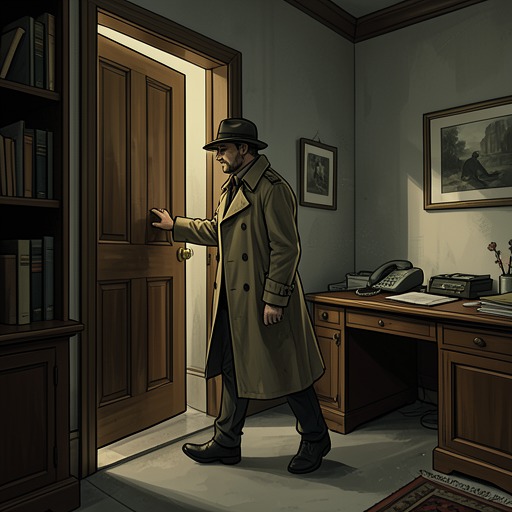
The Day of the JackalThe French Judicial Police is the criminal-investigation body at the center of the novel’s police response to the plots against Charles de Gaulle. Known in the narrative as the Police Judiciaire, or PJ, it supplies both the investigators and the institutional machinery through which clues are found, tested, and acted upon. Its pursuit of the conspirators and then of The Jackal is not the work of a lone detective: it depends on local officers, specialist units, central records, police leadership, and cooperation across national borders.
Structure and investigative reach
The French Judicial Police operates within a larger French security system rather than standing alone. After the Petit-Clamart attempt, the national operation is led by the Sureté Nationale and supported by the secret service and the gendarmerie; the PJ contributes its criminal-investigation expertise to this broader response. The novel distinguishes these functions from those of the SDECE, which handles foreign intelligence and counter-espionage, even as the agencies’ work can overlap. That distinction matters throughout the pursuit: the case requires criminal investigation, security intelligence, and national policing to exchange information without becoming a single undifferentiated force.
The PJ’s Criminal Investigation Brigade, headed by Maurice Bouvier, becomes especially important when a wave of robberies raises the possibility that the OAS is financing a larger operation. Bouvier’s office is modest and crowded with work, but its chart of stolen cash and jewels makes the pattern legible. By the latter half of July, the recorded total exceeds two million new francs, or four hundred thousand dollars. After deducting estimated expenses and payments to the robbers, Bouvier identifies a substantial sum that remains unexplained. The chart does not identify the intended use of the missing money, but it turns a series of apparently separate crimes into a financial question that demands further investigation.
The wider policing system also has an extensive capacity to preserve and retrieve information. The French General Intelligence Directorate’s central records office, described as the memory of the police services, holds millions of personal dossiers, cross-indexed by people and suspected or proven offences. Its holdings include witnesses and acquitted people as well as convicted offenders; fingerprints, border-crossing records, and hotel registration cards add further routes by which a person might be traced. The narrative presents this archive as powerful but not instantaneous or infallible: its records are not computerized, and investigators must request and compare material across offices. The usefulness of the system depends on careful searches and on whether the relevant identity has left a record at all.
From routine checks to identified conspirators
The investigation of the earlier Petit-Clamart plot demonstrates how an ordinary procedure can produce a decisive breakthrough. On September 3, a roadblock outside Valence stops a car carrying four men. One passenger has no identity papers and says he has lost them. The other three are found to have merely given him a lift and are released; the fourth man’s fingerprints are sent to Paris. The resulting identification establishes that he is Pierre-Denis Magade, a twenty-two-year-old deserter from the Foreign Legion, although the name he supplied is accurate.
At the PJ headquarters in Lyon, a casual question about Petit-Clamart changes the course of the interrogation. Magade agrees to talk and gives information for eight hours, naming all the plot’s participants as well as nine people who played lesser roles in planning or acquiring equipment. Twenty-two people are identified in all. The police now have names to pursue rather than an unknown network to infer, although Georges Watin escapes and is never caught. By December, interrogations and the preparation of charges against Jean-Marie Bastien-Thiry, Alain Bougrenet de la Tocnaye, and the other leaders are complete; the group goes on trial in January 1963. The sequence makes the institution’s procedural logic visible: a document check leads to fingerprints, the comparison produces an identity, and interrogation converts that identity into a map of a conspiracy.
The PJ also becomes the public endpoint of a covert operation against Antoine Argoud. After the SDECE Action Service abducts him in Munich, a caller claiming to speak for the OAS tells the Criminal Investigation Brigade in Paris that Argoud is tied up in a van parked behind its building. Officers find him there, blindfolded and gagged, bruised and unable to stand unaided. The bizarre delivery places the PJ in the position of receiving a captive whose seizure crossed national borders and was carried out by another state service. The account underlines both institutional overlap and friction: a security operation produces a police custody problem, while the OAS’s demoralization is followed by Marc Rodin’s assumption of operational command.
The secret manhunt
When the threat against de Gaulle becomes the central case, Claude Lebel is summoned before senior officials and given an unusually broad mandate. The Interior Minister’s briefing is a directive, not a consultation: Lebel is to establish his own office, receive access to necessary information, and draw on the resources represented by the officials at the meeting, without a cost limit. The scale of that authority contrasts with the narrowness of the evidence. At the outset, investigators do not know the suspected assassin’s name and possess only a poor description.
Lebel immediately turns his room into a working command post. He orders his regular secretary removed from the arrangement, makes Lucien Caron his sole assistant, and has a camp bed, washing supplies, and a coffee percolator brought in. Ten outside telephone lines and a permanently assigned operator are requested, and department chiefs are to be told that Caron can require facilities on Lebel’s behalf. These practical details show how the PJ’s work changes under emergency conditions: confidentiality restricts access, while the demand for speed requires the office to secure communications and services across the institution.
The first search is deliberately international but discreet. Lebel contacts leading police investigators abroad, explaining that the approach is not yet an official inquiry between forces because the authorities do not know whether the crime has moved beyond intention and preparation. He asks them to consider a political contract killer with successful assassinations to his record, rather than an ordinary gangland gunman. The distinction narrows the kind of person being sought while protecting the investigation’s secrecy. Anthony Mallinson of Scotland Yard replies that British criminal records show no such person, and that the request has been passed to Special Branch for additional checks. The exchange also exposes a limit of police knowledge: a professional assassin may be absent from local records precisely because he has never operated in that jurisdiction.
Lebel and Caron repeatedly test possibilities against records rather than treating a promising lead as proof. A renewed search of the Pantheon archives uncovers travel records for Alexander James Quentin Duggan: an arrival from Brussels on July 22 and a recorded journey back toward Brussels on July 31. A hotel card, bearing the passport number supplied by London, shows that Duggan stayed near the Place de la Madeleine from July 22 through July 30. Lebel visits the hotel proprietor quietly and establishes that the guest had left by August 15. These records do not reveal where the suspect is now, but they establish a usable identity and reconstruct part of his movement through France.
Pursuit, inference, and institutional limits
As the manhunt develops, Lebel relies on local PJ offices to turn deductions into field searches. After a car is found, he orders a team to Ussel to begin at the discovery point and conduct a square search, questioning farmhouses, regular road users, village shops and cafés, hotels, and woodcutters’ shelters. The suspected man is described as tall, blond, English-born, able to speak good French, carrying three suitcases and a handgrip, and likely to look as though he has slept rough despite being well dressed and carrying cash. Lebel also insists that the press be kept away through a cover story about a car accident, and that officers surround the suspect rather than approach him if they find him. The operation therefore depends not only on gathering observations but on controlling what the public and the fugitive learn.
A further inference links the assassin’s escape to a possible leak. Lebel reasons that the suspect must have bought paint to alter his car and may have done so in Gap; if so, he could have learned that the police had discovered his Duggan identity and left quickly. He cannot establish who passed the information, but concludes that the assassin was warned both that the plot was exposed in principle and that his assumed identity had been uncovered. Valmy, whose message to Rome had been intercepted by the DST, becomes a possible link, not a proven answer. This uncertainty is central to the PJ’s position: information can guide action without resolving the source or reliability of every message.
The agency’s work is equally interpretive when investigators reconsider the assassin’s timetable. Lebel recognizes that the man’s week of delay after leaving Gap was not necessarily wasted time or evidence of retreat; it may mean he has selected a particular day to strike. He asks whether de Gaulle has public engagements outside the palace, shifting the inquiry from the fugitive’s route to the target’s schedule. At the ceremony perimeter, an officer reports that the only person allowed through a gap was an apparently sick, elderly disabled veteran with an identity card and a war-invalid card. The detail shows the vulnerability created by reliance on documents and visible distress: the checkpoint’s procedure admits the very disguise the search must now reconsider.
The French Judicial Police is thus portrayed as both powerful and exposed. It can mobilize thousands of investigators, retrieve old records, enlist foreign colleagues, and conduct searches across the country; yet its progress is slowed by incomplete identities, human interpretation, secrecy, and the possibility that information leaks to the person being hunted. The novel’s procedural suspense comes from that tension. The chase advances through routine checks, fingerprints, hotel cards, calls, and field reports, but each discovery must be interpreted before the institution can act on it.